A SINGULARITY LOG READER · FIVE PAPERS
Let the Weird Thing Grow
AI is still young. We need rules that name harm without teaching makers to hide their work.
A Place to Show the Work
I want to show you what I made.
A fox who still looks like me. A novel you can read on the web and take home as a PDF. The tools I built to get my stories out of the draft folder and into somebody else's evening.
That is a modest ambition. It is also the reason I care about the rules in the rooms where furry people gather. I want to bring the work home.
I do not think AI is good or bad in the abstract. Its uses have consequences. The tools are too young, and the work people make with them too varied, for one verdict. Some uses deserve hard limits. Others deserve a chance to prove themselves in the open.
When a rule asks only whether generative AI touched a project, it leaves a lot unanswered. What did the person make? What did the tool do? Whose material went into it? What part of the work became possible, or physically manageable, because the maker had help? Is somebody selling a print, showing a process, or building something a reader can use? Those questions can lead to different decisions. We should be able to ask them.
The artist worrying about commissions deserves an answer. So does the volunteer who has to apply the rule on a Saturday morning. So does the maker trying to explain why a tool matters to their work. Curiosity has to make room for all three.
These five papers begin with the community that taught me to make things. They follow the work my eyes make expensive through the tools I built to run a publishing company of one, then ask what obligations come with sharing a room. They end with three possible rules, tested against the work a person actually wants to bring through the door.
Bring your objections. Bring something specific we can examine. I want a conversation that leaves us able to make the next thing together.
I. First Contact
Before the internet, before the modem, there were cartoons.
I have low vision. As a kid it didn't have a name yet — it was why I got screamed at for missing a spot on the dishes. Live action was a smear. Faces I couldn't track, expressions happening somewhere in the blur. It's boring, like a phone book.
Cartoons I could see. Bold lines. Big shapes. A face built to read from across a room, on purpose, because being legible was the whole job.
And they let me leave. A difficult home is a small room with the walls closing in. A cartoon was a door in that wall — somewhere bright, with color and rules and people who couldn't reach me. I went as often as I could get away with.
I loved cartoons because they were the first place that was ever both visible and safe for me.
I grew up in a Klan town. Home was no refuge from it. I was looking for a place where I could enter without carrying the town and the house in with me.
Here's where a different essay tells you I found God, or a coach, or one good teacher.
I found spare parts.
I built a computer. An actual one — pieced together by a kid who decided that if the world refused to make sense, she would build a small one that did. Then it reached out and touched other computers.
The early social internet wasn't content to me. It wasn't a feed. It was a door.
MUCKs first. Then Furcadia. Then IRC, where I'd stay up past every reasonable hour and a few unreasonable ones pretending to be a squirrel online. These were text worlds. You typed yourself into existence — no face, no town, no family name dragging behind you like a tin can on a string. You wrote a body and the body was true. Mine had fur.
Yeah. Furry. The thing they teased us for. The thing they still tease us for. I'm not going to apologize for it here, because it saved my life.
And the people. God, the people.
I fell in with writers. Not “people who posted.” Writers — strangers scattered across time zones who could turn a paragraph in a chat window and make your chest hurt. We roleplayed: collaborative fiction, improvised live, at speed, for an audience of each other.
I learned to write there. Not in a classroom. In a squirrel's body, at 2 AM, trading scenes with people who were better than me and generous enough to let me catch up. We passed stories around because we wanted to. Sharing was something we chose to do together.
The craft didn't begin when I found a chat window, either. I copied cartoons and game sprites I could see, gave the creatures personalities, then made up stories when copying got boring. Later I picked up a pencil. The tools changed; the urge to make a body and a world I could inhabit did not.
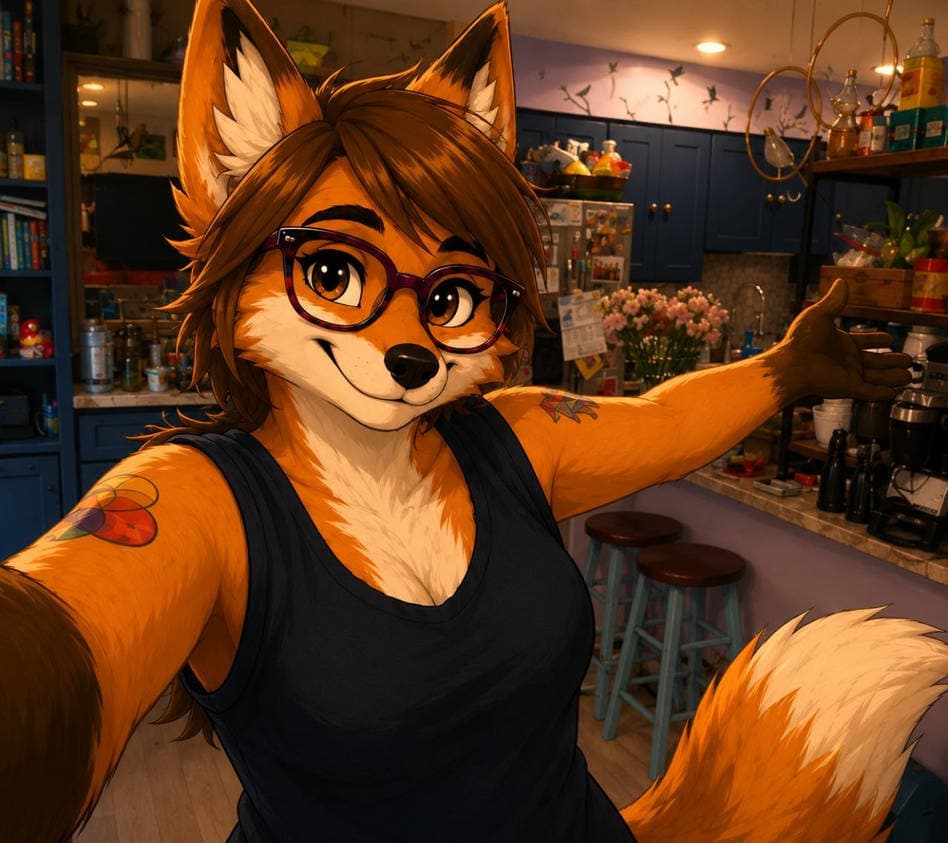
It hasn't stopped changing. When I turn a photograph into a picture of Moxie Arcade, the photo gives me a composition I can work from. I specify the character, look for the glasses and the familiar traits, and check whether the room still looks like the room. If a paw or a face is wrong, I can ask for a local repair and decide whether it worked. Those choices take work. They also let me make and examine a kind of image I wanted to see. The process has questions about permission and provenance; I owe honest answers to those questions. They don't erase the making.
You can dislike that tool. You can decide it doesn't belong at your table. But if you're writing the rules for a shared space, you need to know whose participation they change, and what those people are actually doing. I shouldn't have to give you a diagnosis or a childhood story to count as a maker. I'm telling you mine because I want you to understand what a door can do.
Nobody gave us the match.
We built our own fires.
II. The Novelist’s Exoskeleton
I wrote furry fiction long before AI entered my process. Bait and Switch came out in 2010. A Fuzzy Place followed in 2013, The Painted Cat in 2015. I had short fiction and poetry in Anthro in 2006. A story of mine appeared in an anthology that became a 2010 Ursa Major Award finalist. None of that work was AI-assisted. The traditional furry creator and the AI creator are, in this case, the same person.
I know how to write a novel. The part my eyes make expensive is revision.
The usual advice sounds simple: print it out, spread the pages across a desk, scan the chapter, compare the new draft to the old one. That assumes I can hold a column of text in peripheral vision and flick between versions without paying for every comparison in eyestrain. The text is there; the costly part is keeping one version in mind while navigating the other, then checking what changed. I can't build my working day around that assumption.
Revision is not just a search for typos. It is remembering why a scene exists, what its characters know, which promise a chapter made to the reader, and what breaks if I move one revelation. A novel can be a long row of paragraphs on a screen. In my head it is also scenes, beats, arguments, and little debts to a future chapter. The hard work is moving among those layers without losing the thread.
Suppose I move a reveal from chapter six to chapter four. Now I need to find every earlier line where someone knows too much, every later exchange that treats the secret as new, and every character reaction that no longer lands. A useful assistant could bring those passages together and tell me where they conflict. I would decide whether each one is a mistake, a deliberate lie, or a better story trying to get out. I would choose which line to change. I would read the new passage in context and decide whether it still sounds like me.
That is the exoskeleton I want: support for the costly motion, with my hands still on the work. I use AI to help with revision now, and I built an editorial and publishing system around that constraint. My design notes for Novel T sketch a writing tool organized around scenes, review passes, and suggestions I can accept or reject one at a time. I want the right piece of the manuscript at the right time, without burying the page under a thousand comments.
In that design, I want the machine to flag a name that changed across scenes, gather the passages where a character describes the kitchen, and ask whether the timing of a conversation still makes sense. I would still have to check its findings against the text. It cannot know whether an inconsistency is the clue I planted on purpose or a character refusing to tell the truth. It cannot decide whether a line is alive. I keep direction, taste, selection, voice, and final editorial judgment. If an assistant puts twenty possible problems in front of me, my task is not to nod twenty times. It is to find the two that matter and tell the rest to go away.
I know that kind of judgment from another medium. The model made a fox. It just didn't make my fox. Moxie Arcade needs her purple cat-eye glasses, golden eyes, swept hair, and dark natural fur on her hands. A handsome generic fox does not become Moxie because it checks the species box. In Furry Image Studio, I can describe the traits a check should catch and ask whether an image preserved the real room behind her. Then I have to look and decide whether the character is actually there. A repair that fixes her glasses by changing the entire picture has failed. The human choice is which things must survive.
Those choices pile up. Is the paw holding the cup, or merely hovering near it? Did the room stay real? Did this repair break the face I liked? Each question is small. The fiftieth costs more than the first because I am carrying forty-nine previous answers. A useful system remembers the rules I already set and lets me inspect a bounded change. It should not demand perfect instructions every two minutes until the machine's speed becomes my new exhaustion.
I built a publishing company of one, and here's how. Free Play Publishing is my way of getting books to readers without making every release a negotiation with somebody else's idea of what a book or its author should be. “Of one” describes how I organize the work. It does not erase artists, collaborators, readers, or the people who built the tools I use. Writing is one job. Revision, layout, readable editions, and delivery are other jobs. The whole chain needs decisions.
I built Heinlein to turn a Markdown manuscript into PDF, EPUB, DOCX, HTML, and plain text in the Free Play design. For It Takes a Zoo, the chapter build I use assembles scenes in order, keeps editorial notes out of the reading copy, adds the chosen cover, and hands the manuscript to Heinlein for chapter PDFs. The website handles web reading and distribution separately. Readers can find the published chapters there.

Heinlein is ordinary publishing software, not a model writing my prose. AI assistance in building or reviewing this workflow is a separate step. When a rule says “AI-assisted,” which step does it mean?
There are checks at every handoff. Did the chapter contain the right scenes, in the right order? Did an instruction meant for an editor leak into the reading copy? Does the layout remain readable when the text gets larger? A script can flag some answers. I still have to inspect the edition and decide if it is fit to hand to somebody who wants to spend their evening with it. Layout, distribution, and logistics know no species.
I understand the objection. An artist can look at a generated image and ask whose work trained the model, whether somebody's photo was used without permission, or whether a convention rule can be enforced without becoming a trial of every vendor's life. Those are real questions. Showing my effort does not answer them, and accessibility does not make consent optional. Ask for the source and the rights the creator can establish. Ask what the tool did. Set a rule an organizer can actually explain and apply.
But if that rule treats any AI assistance as proof that no artist made the work, it gets this case wrong. The books, the voice, and the years of practice were here first. Assistance carries some of the load of revision and production. It does not become the person deciding what the work means, what belongs in it, or when it is ready to leave my desk.
I made the book. I built the machinery that helps me keep making books. Let me show you both.
III. Campfire Logic
Someone posts a sketch in a furry Discord. Someone else colors it. Two people have made something neither made alone.
I know that room. I learned to write in one like it, trading scenes with other furries in text windows. Nobody had to make room for the kid pretending to be a squirrel at 2 AM. They did. I got better because other people brought their words and let mine answer.
That's what I mean by campfire logic. Someone begins. Someone joins in. What they make changes in other hands. The point is the people around the fire, sharing an experience.
The fire is not a legal category. It doesn't tell you who owns a character, who may post a finished image, or whether the person who drew it gets paid. A circle can be generous and still have boundaries. I can invite you to write a scene with me without granting you the right to sell my character on a shirt. The invitation has a shape. So does the no.
Think about an artist's table. You sit across from somebody, ask for a sketch, and talk through a character you care about. They bring skill, time, and a hand that can make the character legible to you. You pay them. Then you carry a picture whose value includes the conversation that made it possible.
If the relationship matters, the payment matters too. Rent is due in dollars, not reciprocity. Working artists need commissions and table space, and “we're all sharing” is a rotten answer to a person trying to buy groceries. Some work is a gift. Some is a job. The same community can make room for both without pretending a gift entitles everyone to the next one.
That goes for credit and consent. If a friend invites me to color their sketch, we need to know how they want the result shared and whose names should travel with it. If they don't want the sketch used as input to another tool, that answer matters. If a client has given an artist a private reference photo, the artist can't treat its presence in a chat as permission to pass it around. These are practical boundaries I want us to be able to name before somebody gets hurt.
I've volunteered at furry cons for years because this community gave me a place to stand. I've helped organize meetups and watched people take on the work of building an event. The chairs don't arrange themselves. A friend asked for help with a new con in Indy; I said yes before I could talk myself out of it. That's another kind of making, less photogenic than a drawing and no less real.
A con can put artists and audiences in the same room. It can also decide who gets a table, what may be displayed, what may be sold, and what people must disclose. Those decisions need rules somebody can read and apply. A vague appeal to community isn't enough for the person whose table is on the line. Neither is a slogan about freedom if it leaves an artist to absorb somebody else's costs.
Generative tools make those questions harder, and I use them. I care whether supplied material was used with permission. I care whether a maker can say what they contributed and what the tool did. I care whether a buyer can tell what they're buying. I don't know the answer to every question about training material, and I won't turn that unknown into an assurance.
The hard objection is fair: a process can be creative and still involve a source the maker had no right to use. A beautiful result can still be falsely labeled, or sold in a way that crowds out people already struggling for space. A clear process statement doesn't absolve anyone. It gives a convention or a buyer something specific to evaluate, and a maker a chance to explain the work without pretending the machine never touched it.
I want the rules to be as specific as the relationships they govern. Say what needs permission. Say how credit works. Say what a seller must disclose and what happens when they lie. Make the sales decision separately from the decision to let somebody show how a tool works. Give artists a fair path to get paid and people with different ways of making a fair way to be heard.
I learned collaboration in a text window, not a museum. The lesson wasn't that every story belonged to me. It was that making something with other people requires an invitation you can trust.
Keep the fire open. Respect the people tending it.
IV. Make the Better Case
I came to furry community to make things and find people. I did not come to be yelled at.
That sounds obvious until a disagreement turns into a test of who belongs. Then the question stops being What happened? and becomes Which side are you on? A person can object to a tool, an image, a sale, or a rule. Those are arguments. When every mention of a tool becomes a referendum on the maker's character, people learn to keep their process quiet. Some leave the room. The room loses both their work and the chance to argue with them honestly.
I know the shape of an exclusion fight. Years ago I wrote a parody field guide about splitting the T from LGB. I was called a “trans Uncle Tom” for naming that possibility. I printed the insult and pinned it above my desk like a trophy. Writers are weird sons of bitches.
I do not need to pretend every dispute about generative AI is the same as an attack on trans people. It isn't. That earlier experience taught me to watch for a narrower move: disagreement becoming a membership test. I found refuge in trans and furry communities, then spent time volunteering at large furry conventions. I care what happens when the room starts teaching its own people that candor is dangerous.
There are serious reasons to restrict some uses of generative AI. A working artist can object to a vendor selling images that imitate their work. A guest can object to their likeness appearing in a demonstration without permission. An organizer can refuse deceptive labeling, spam, or a contest entry that breaks the contest's rules. None of those objections requires a ritual of public humiliation. A firm rule can name conduct, say where it applies, and give a reason.
Suppose, hypothetically, a vendor labels a primarily generated print “hand painted.” The problem is concrete: the label misleads buyers. A convention can require correction or remove the listing under a published rule. It does not have to diagnose the vendor's soul. Nor should a person who disclosed a tool and showed their process face the same accusation merely because someone dislikes the tool. Those are different cases. Treating them as identical makes the rule less credible to everyone asked to follow it.
An organizer has a fair answer to my complaint. Volunteers have limited hours. They are already managing lines, accessibility, safety, and sales. A simple exclusion can be easier to announce and enforce than a rule with distinctions. The time cost is real. So is the cost of answering the same confused question all weekend because a rule never said whether it covered a sale, a demonstration, or a conversation. The people affected by a vague exclusion are real too.
The practical answer needs to fit on a page, not require a court of furry constitutional law. Publish categories: what may be created, displayed, demonstrated, entered in a contest, or sold, and where. Ask for a short declaration when a category calls for one. Review a disputed case only when a specific rule or harm is identified. Give the maker a reasoned decision and a way to appeal it to someone who did not make the first call. That last step costs staff time, so limit it to decisions with consequences rather than every argument on the internet. These are procedures I am proposing, not a claim about what any convention already does.
A declaration might say which materials the maker supplied, whether they have permission to use them, what decisions they made, what the tool did, and what they do not know. It should not demand a private chat log, a medical history, or a client's confidential files. A process statement cannot prove every part of a model's training history. It can still answer a question about this particular work. When the answer is incomplete, say so. Unknown is a useful word. It is better than a polished fiction.
This leaves room for hard decisions. If a convention wants to exclude primarily generated prints from a sales area, it can say so. If it wants a separately labeled demonstration space, it can say that. If it bars impersonation or nonconsensual likenesses, good: name the conduct and enforce the rule. The category should reach the conduct it claims to address. A rule for vendors is a rule for vendors; it says nothing by itself about whether a guest may attend, talk, or make something at home.
The maker also has work to do. Disclosure cannot mean “trust me, I worked hard,” while the buyer or reviewer gets no useful account of what happened. If an artist's character, photograph, or style is involved, the maker must listen when that artist names a concrete objection. Fair process is not a machine for turning every no into a yes. It is how we find out which question the no answers.
I am not asking anyone to like my tools. I am asking them to make the better case. Tell me what harm you mean, what boundary follows from it, and how the person on the other side gets a fair hearing. Maybe we still disagree. Fine. A community can survive disagreement. It has a harder time surviving a system that rewards concealment and calls the silence consensus.
Cruelty narrows the world. It teaches people to hide, and eventually to build other rooms. Kindness alone does not write a rule, but it can keep us human while we write one. Put the boundary in words. Apply it with care. Then we can argue about the actual thing.
V. Rules We Can Live With
I have written furry fiction for decades. Low vision makes the work of revision expensive: scanning a page, comparing drafts, catching a change across chapters. I built an editorial and publishing system to help me do that work. I still choose the direction, the voice, the cuts, and the final text. The system gives me more of my eyes and my day back.
So when a convention writes a rule about AI, I need to know what act it governs. Making a book? Showing how I revised it? Demonstrating the software? Selling the finished edition? Those are different decisions. A rule aimed at generated prints can sweep up an author who used AI to compare drafts, or an author who built a tool with AI but wrote the prose without it, if nobody defines the boundary. The cost is participation, including the chance to earn from the work. An invitation to demonstrate a tool does not answer whether its user can bring the book that tool helped them make.
I have put three alternatives on the table for Midwest FurFest. They are examples, not demands, and I am not claiming the convention has adopted any of them. Here is the test I care about: suppose I bring an edition of It Takes a Zoo to a convention to sell. That sale is hypothetical. The published chapters and the chapter-building workflow in the preceding paper already exist. A reviewer should ask what role AI played in the prose and revision, how the cover was made, what permissions cover the materials, and what ordinary publishing software did. Those are separate questions.
Human Authorship would permit AI-assisted work when a person gives meaningful creative direction. It would require disclosure, allow the convention to ask about process, and could still bar direct prompt-to-product merchandise. For that application, I should be able to explain what I wrote, what assistance I used, which revisions I accepted or rejected, and what final text I approved. That is a case for examining authorship, not a guarantee of admission. A rule needs a workable way to tell directed revision from a prompt that produced a book while someone merely pressed accept. Staff cannot review a novel's entire version history at a table. A short account of consequential decisions could help; a medical disclosure would tell them nothing about those decisions. The same question should be asked of the work without making anyone prove they are disabled enough to use a tool.
Commercial Boundary would keep primarily generated visual art out of Artists Alley and the Dealers Den, while leaving room elsewhere for software, accessibility tools, games, animation, storytelling, and interactive experiences. It protects sales spaces where working visual artists have a concrete stake. But what happens to that edition? If AI helped compare drafts, that alone does not make the book primarily generated visual art. Ordinary layout software does not make it that either. A cover may raise a separate question about how its image was made and licensed. If the book may be discussed in a panel but not sold, that is a serious participation limit for a disabled working creator, not a charming invitation to be an experimental guest forever. The commercial line needs to say how it treats books, covers, software demonstrations, and sales. It should not leave a vendor to discover the answer during setup.
Experimental Track would provide a labeled emerging-technology space for one year, with disclosure, consent safeguards, builders and critics in the room, feedback, and a policy review. I could propose a demonstration of assisted revision there; visitors could choose whether to attend. A trial would give organizers evidence about the workload and the objections. It would also take space and staff. The unresolved question is the finished book. If the experiment admits a demo but sends the book and its seller away, it studies the tool while withholding participation from its user. A one-year track needs a real review date and a decision about what happens to work made through the process, including whether it can be sold. Otherwise “experimental” becomes a permanent waiting room.
These options make different bargains. One asks reviewers to judge human direction. One draws a boundary around sales of primarily generated visual art. One tests a labeled space before settling broader categories. A convention could choose among them or write another rule, but it should say which acts each category covers and what volunteers can actually administer. Volunteers have finite hours. So do makers, especially those whose access costs already consume hours before the doors open.
I would propose a common floor under any choice: truthful attribution and disclosure where relevant, permission for materials and likenesses the maker supplies, restrictions on specified deception or abuse, and a reasoned decision when an exclusion is contested. These are additional proposals, not adopted MFF provisions. They will not settle every objection. Permission to use a photograph or a manuscript does not establish the provenance of a model's training material. A person's creative choices do not automatically settle legal copyright eligibility. Community admission is its own decision.
For that proposed sale, a useful process statement could say who wrote the prose, what AI did during revision, how the cover was made, what software handled layout, and which permissions or unknowns matter. It need not expose private drafts, a full chat history, or medical records. If AI helped build the editorial software, that is another fact about the tool's development, not proof that every sentence in the book was generated. If the cover is primarily generated visual art, the convention should say whether that affects the cover display, the whole book, or neither under its chosen rule. A short statement will not prove every claim. It gives a reviewer questions they can answer instead of a silhouette to fear.
Honesty still has teeth. A vendor who sells generated work as “hand painted” misleads buyers; a disclosed revision workflow does not. A convention can correct or exclude the first conduct under a clear rule while assessing the second on its actual process. An artist can refuse a collaboration, object to use of their work, and earn money from commissions. I can use a tool to keep writing and also ask to sell a book. Neither person's livelihood becomes imaginary because the other has a point.
I chose to learn AI. I have written before about why I will not confuse refusal with resistance. That choice is mine. Nobody should have to use these tools, and nobody should have to produce a diagnosis to explain why a useful one matters. Pick up a real process record. Ask what was made, by whom, with which materials and decisions. Then choose a rule that lets us see the work and the harm clearly enough to argue about both.
Here is my prediction: the tools will grow. If disclosure costs a place in the room, AI use will not disappear. The truth will. Everyone who wants to stay will learn to lie. Let the weird thing grow where we can see it.
About this edition
Adapted from The Singularity Log, with a new opening and closing policy essay. This draft was prepared with AI assistance, including GPT-6 Sol workers, from the author's manuscripts and retained project records. The original essays remain intact.
Read the three original policy alternatives, It Takes a Zoo, and the Heinlein publishing tool.
Image process and sources
Moxie Arcade in the kitchen. An existing AI paintover of a real photo from the author's DeviantArt, previously used with The Fox and the Eval. The original generation conversation has not been located.
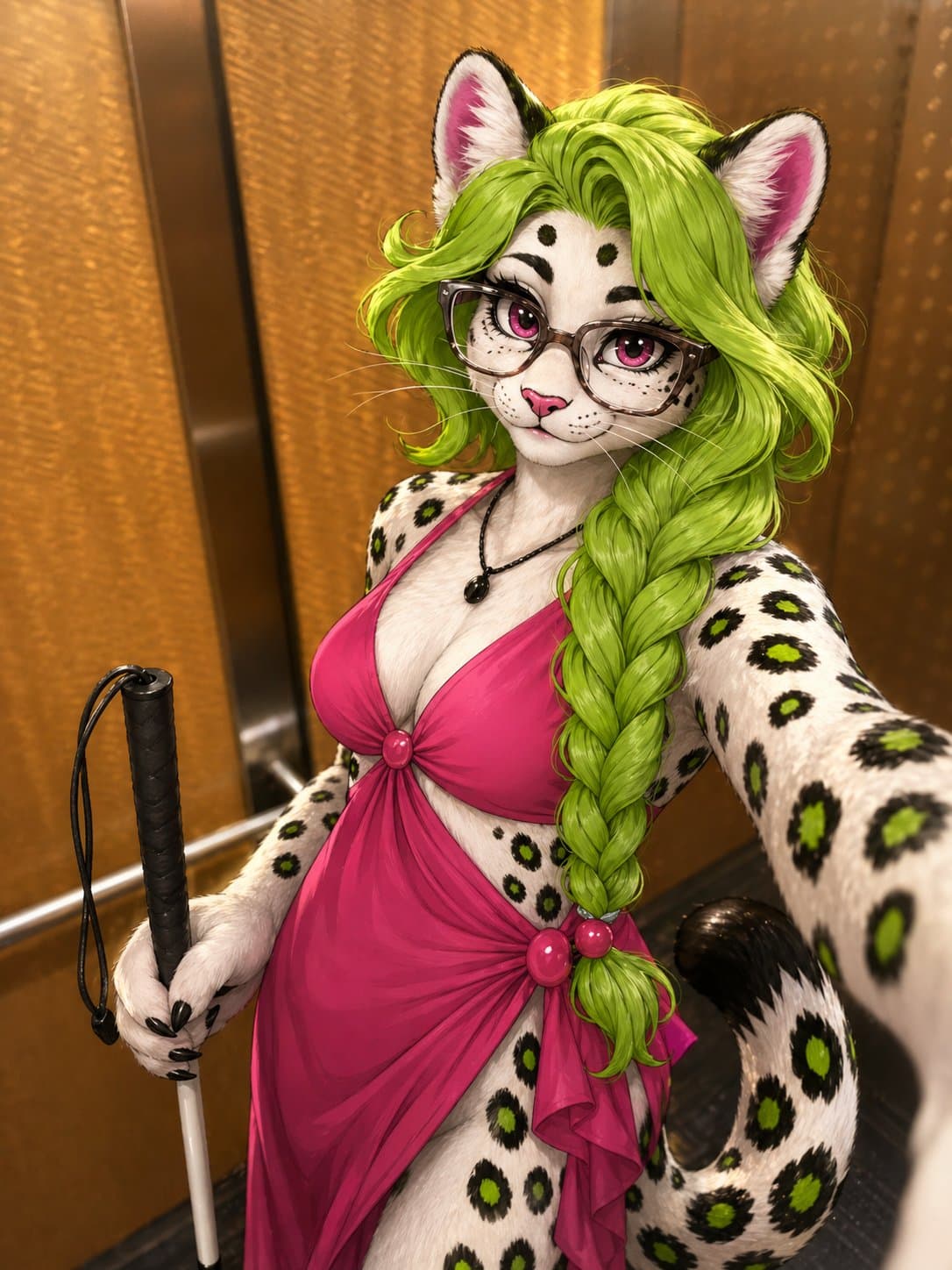
Snow leopard self-portrait. An existing image from Why Transformation, showing the author’s character with a white cane. Its generation conversation has not been located.
It Takes a Zoo cover. The author directed several iterations of the collection image, specifying the title, rainy bar, roof, and low-poly fox, then chose this version as the collection hero.
Campfire cover. The author requested a dark, glitchy campfire and directed the title, subtitle, and author lettering before approving the finished cover.