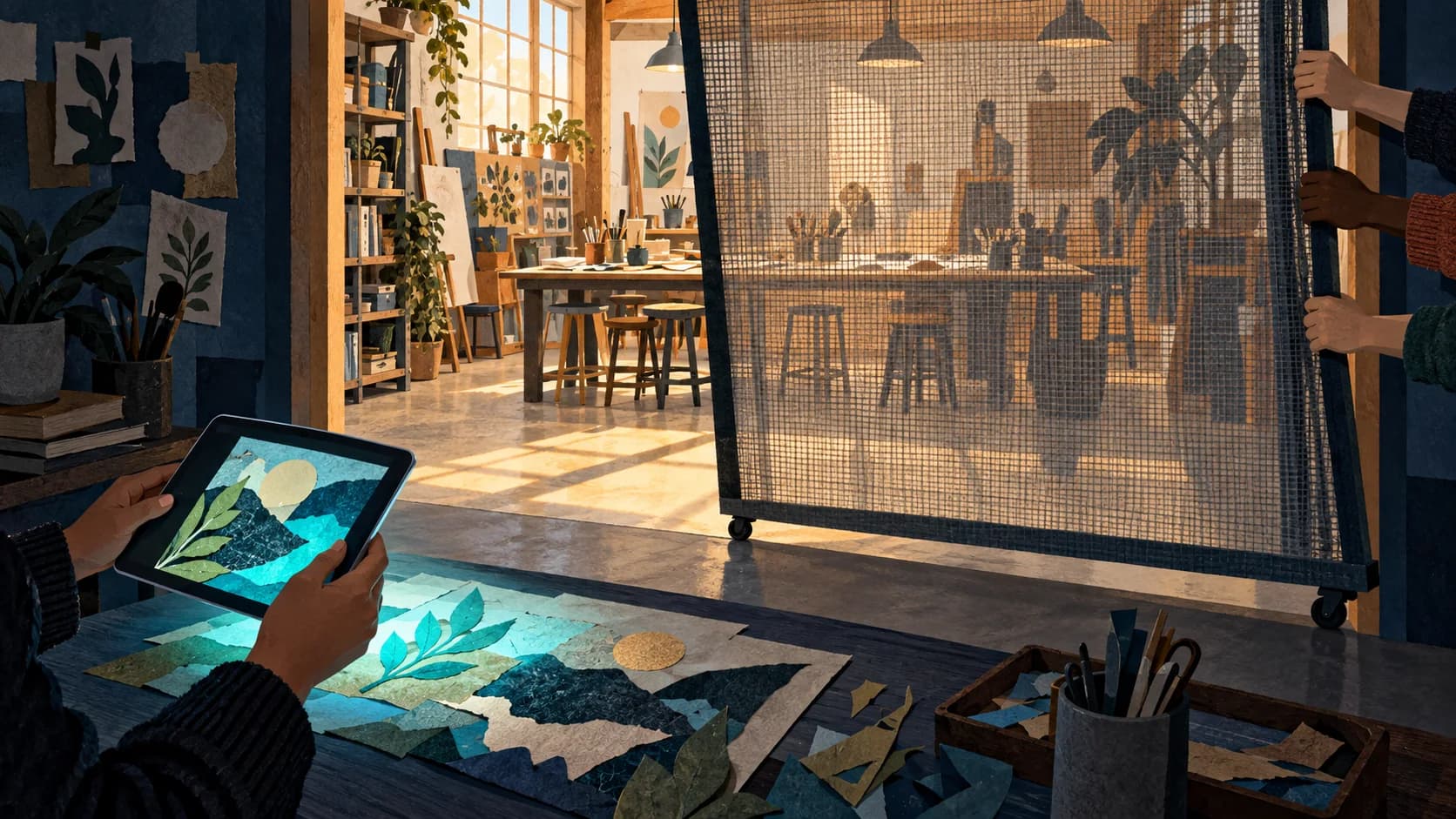
Over the last few years, my usable vision has been packing its bags. At roughly the same time, machines got scary good at turning language into visual information and visual information back into language.
The timing is so neat that if I wrote it into a novel, I'd cut it.
My vision loss didn't cause generative AI. Generative AI didn't cure my vision loss. But the two timelines crossed in my life, and where they crossed, a door opened.
Before, whole categories of visual work sat behind glass. I could describe what I wanted. I could write characters, imagine systems, direct, critique, and tell you when something felt wrong. What I couldn't do was inspect a complicated composition, push pixels with any precision, or sit down and draw the thing in my head. Hell, I can't even read a tape measure anymore.
Then the interface changed, and suddenly I could work visually through language.
I could describe a character and get something back. I could ask what was wrong with an image and hear the answer: the wings are duplicated, the face reads too young, the silhouette's mush. I could say move this, cut that. I could ask a photograph what it was holding.
I could iterate. I could direct. I could participate.
AI didn't replace my creative process. It gave my creative process a way into visual media. Call it a ramp around back. And the feeling wasn't, “Great, now I don't have to make things.” It was: wait. I get to make this too?
For a little while, that was pure cartoon delight.
...and by a little while, I actually mean 5 years of nonstop creative bliss brought on by being able to explore things that were inaccessible to me before.
I got in. And then the community decided the way I got in did not count.
I know this pattern. Disabled and trans people get very practiced at finding the person hidden inside a supposedly neutral rule. The default interface assumes you can see it. The default restroom assumes everyone knows where you belong. And the default definition of an artist assumes a particular set of hands and eyes.
Pointing out that assumption can get treated as the disruption. But I didn't put it there. I'm telling you what the rule costs me.
That's the part of this conversation that's been hardest to explain.
I've spent more than twenty years in furry fandom. I've written ten novels in it, including the Ink & Paint trilogy. I've volunteered in it, organized in it, watched it grow up, and grown up inside it. This isn't an abstract audience to me. It's one of the places where I learned how to become myself.
Which is why this hurts.
I hate conflict. It makes me feel unsafe, and it wakes up impulses I'd rather leave dormant. But there are moments when keeping the peace means surrendering something I can't afford to give away. This is one of them. I have to defend my place in the community where I grew up.
The easy version of this argument would be “AI good.”
That's not my argument.
I don't believe every use of generative AI is good. I don't believe artists are wrong to have concerns about training data, labor, attribution, imitation, flooding, deception, or the economic effects of automation. Accessibility isn't a magic word that makes every ethical problem disappear.
Accessibility does not mean no rules. It means accessibility has to be considered when the rules are written.
For some disabled people, systems like these function as accessibility technology. They reduce barriers between an idea and a medium. They translate information into forms we can use. They give us alternate routes into activities that were previously difficult, expensive, dependent on another person, or simply closed.
That doesn't require everyone to like the technology. It does require people writing policy to account for what happens when they ban it wholesale.
If the harms we're worried about are deception, impersonation, plagiarism, spam, commercial flooding, false attribution, or mass-produced low-effort work, then regulate those things.
Regulate the conduct.
Don't assume that every person using the tool is doing the same thing, for the same reason, with the same relationship to the medium. Because when you prohibit the tool itself, you don't only stop the behavior you dislike. You also take access away.
I know what that access meant to me. I'm not the only one.
One of the stranger effects of the current climate around AI in furry spaces is that it's nearly impossible to know how many people are curious. The room is too hot. Maybe they're disabled. Maybe they're writers who want to make images, visual artists experimenting with different workflows, programmers making strange toys, or simply curious people who don't want to turn that curiosity into a public declaration of ideological allegiance.
They look around, feel the temperature of the conversation, and decide not to touch anything. Not because they've reached a thoughtful conclusion about the technology. Because they don't want to become the next subject of the discourse.
I understand that instinct. I also think we lose something when a creative community makes curiosity itself feel reputationally dangerous.
That realization changed what I thought I was fighting for.
At first, I thought I was defending my own place. Then I realized one exemption for one stubborn person wouldn't solve the problem underneath it. An accessibility model that requires you to be articulate enough, connected enough, angry enough, or established enough to argue your way into an exception isn't much of an accessibility model.
So I started building something else.
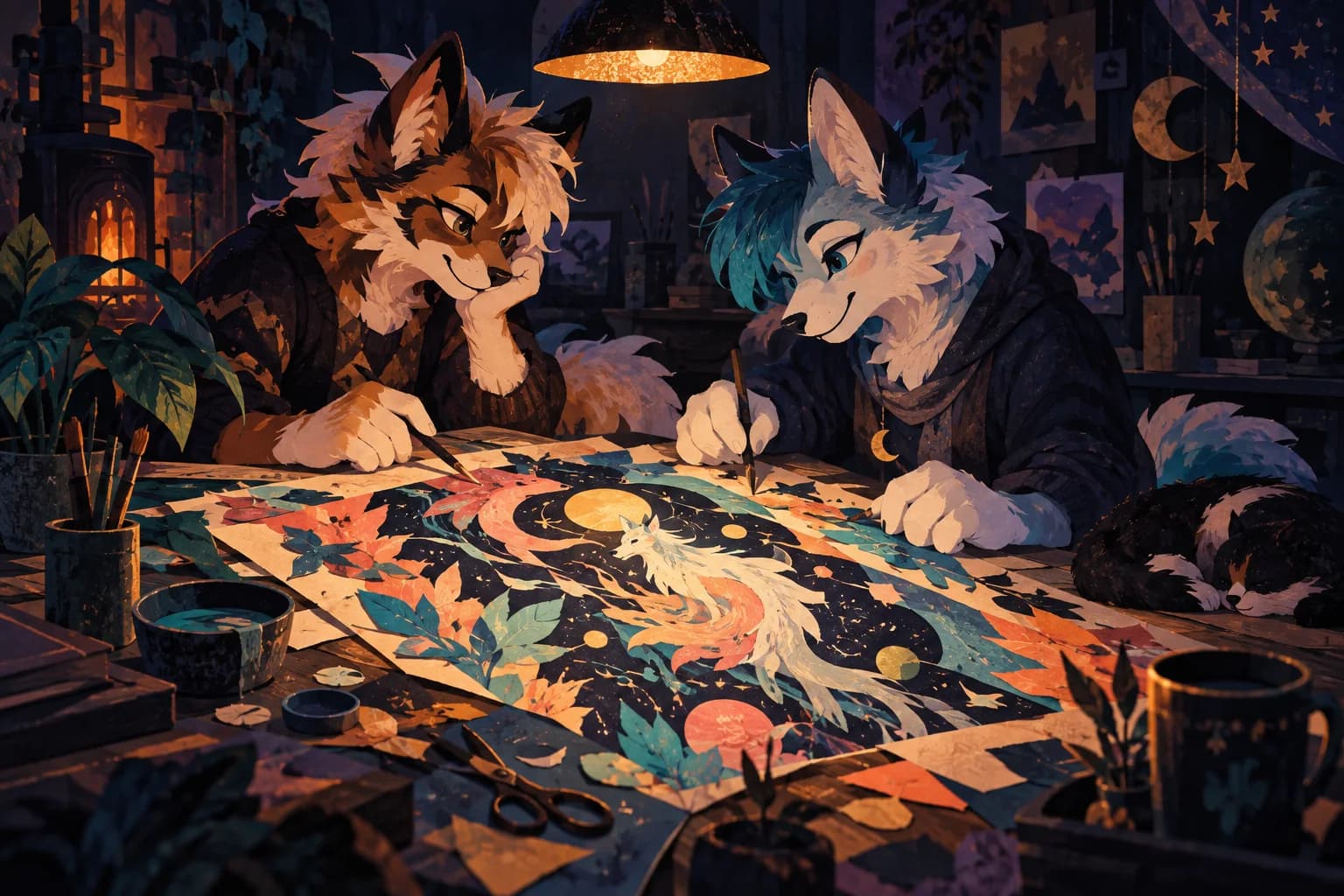
It isn't an AI club, a rival convention, or a purity movement in the other direction. It's a decentralized creative network.
Small on purpose. Two people are enough. Find one person you trust. Make something strange together. Invite someone else if it feels safe. Use your real name, or don't. Show your work publicly, or don't. Use AI, or don't.
I just want you to make things.
I want small creative cells where people can experiment without first volunteering for a public political identity. Places where anonymity is respected, participation doesn't require disclosure, and nobody gets drafted as a spokesperson for a technology just because they used it.
Basically, I want to bring back pre-social-media creative culture so badly that I'm willing to become inconvenient about it.
That's why the network is decentralized. No single board should be able to revoke everybody's permission to create. No single event should define the acceptable tools for an entire culture. No single public argument should determine who feels safe enough to experiment.
I'm not interested in building another gate. I'm interested in building more doors.
There's a practical accessibility principle in that structure, too. Accessibility isn't only about whether a tool technically exists. It's also about whether a person can use it without paying an unbearable social cost.
If the technology gives someone access but the surrounding culture makes using that access dangerous, humiliating, or isolating, then the barrier has not disappeared. It has moved.
I know what it feels like to suddenly discover that a medium you thought belonged to other people might belong to you, too. I also know what it feels like to have that discovery followed almost immediately by a message, explicit or otherwise, that your route into the medium is illegitimate.
I hate that people I care about are upset. But their discomfort doesn't obligate me to disappear so everyone else can become comfortable again.
That's the boundary I've reached.
I'm not asking anyone to declare AI good. I'm not asking anyone to abandon real concerns. I'm asking the community to recognize a fact that's true whether or not the conversation has room for it:
For some of us, these systems are access.
They let us do things we couldn't do before.
That deserves to matter.
I will keep building other doors.